ICLEMAS 2025 · 11th International Azerbaijan Congress on Life, Engineering, Mathematical, and Applied Sciences
Selection of the Most Suitable Parameters for Classification of Hazelnut Fruit Using ShuffleNet Deep Learning Algorithm
Summary
At a Glance
The same lightweight network, ShuffleNet, is trained three times on hazelnut photos with three optimizers: SGDM, ADAM and RMSprop. Which training setting classifies best?
99.94% test accuracy, 7 errors.
99.96% test accuracy, 4 errors: the recommended setting.
99.92% test accuracy, 9 errors.
Introduction
Why Sort Hazelnuts Automatically?
- Before storage, hazelnuts are cleaned and bad nuts and inner nuts (kernels without shell) must be removed.
- Bad nuts left in the lot lower the yield (randıman); inner nuts left in storage can spoil.
- AI can classify nuts from images by quality, size and colour, faster and more consistently than manual sorting.
- On a sorting line the model must run on modest hardware, which motivates a lightweight network.
For ShuffleNet on this task, which optimizer gives the best accuracy?
Early disease detection, yield analysis, automated harvesting and processing.
Introduction · Related Work · Interactive
Earlier Hazelnut Classifiers
Results as reported by each study; tasks and data differ. Click a column header to sort.
| Study | Input | Task | Method | Reported result |
|---|---|---|---|---|
| Khosa and Pasero, 2014 | X-ray images | good vs damaged or infected | feature extraction, anomaly detection | 748 healthy, 20 damaged, 20 infected samples |
| Solak and Altınışık, 2018 | photos of 25 nuts | small, medium, large | OpenCV, Weka, K-means | 90–100% agreement |
| Koç et al., 2020 | photos, in shell | 3 cultivars | random forest (bagging) / DL4J | 83% / 71% accuracy |
| This study | photos, 15,770 images | good, bad, inner | ShuffleNet with 3 optimizers | up to 99.96% test accuracy |
Materials and Method · Dataset · Fig. 1
The Hazelnut Dataset
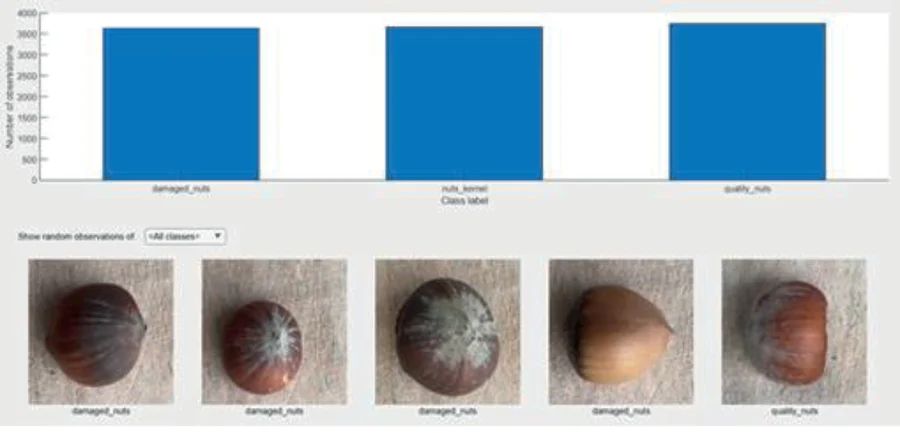

Fig. 1: class counts and sample images (dataset by Güneş, 2022)
- Rear phone camera, 12 MP; photos at 3024×3024 on a platform, one nut per image.
- Expert labels: 519 bad, 535 good, 523 inner hazelnuts.
- 10 photos per nut from different angles: 15,770 images.
- Cropped to 1000×1000, then resized to 224×224.
Materials and Method · ShuffleNet · Interactive
ShuffleNet: Cheap Convolutions That Still Mix
- Pointwise group convolution: 1×1 convolutions split into groups, cutting computation.
- Channel shuffle after the first 1×1 group convolution lets groups exchange information.
- Depthwise 3×3 convolution; with stride 2, a 3×3 average-pooled shortcut and concatenation instead of addition.
Diagram of the shuffle operation (Zhang et al., 2018), not the trained network.
Study and Findings · Optimizers · Interactive
Optimizer Lab: SGDM, ADAM, RMSprop
SGDM: vt = β vt−1 + (1 − β) ∇L(θt), θt+1 = θt − α vt, β ≈ 0.9. ADAM: per-parameter steps from the mean and variance of the gradients. RMSprop: divides by a running average of squared gradients with a forgetting factor.
A toy two-dimensional loss surface, not the hazelnut network.
Study and Findings · Figs. 2–4 · Interactive
Training Runs in MATLAB
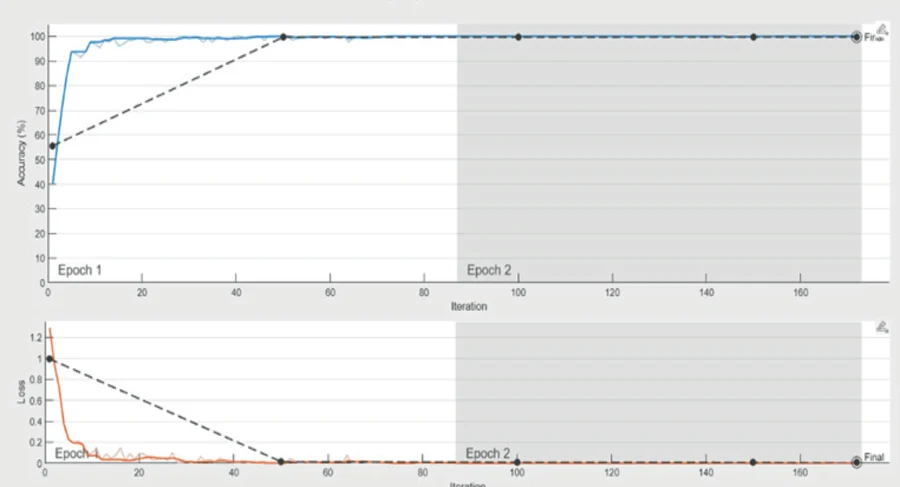
- MATLAB, data shuffled, split stated as 30% training and 70% test.
- Training panels (ADAM, RMSprop): 2 epochs, 172 iterations, constant learning rate 0.001, single CPU, about 55 minutes.
- Accuracy passes 95% within the first epoch.
Study and Findings · Results
Accuracy and Errors per Optimizer
Lighter bars: training accuracy; darker bars: test accuracy. Red dots: misclassified images in each confusion matrix (11,039 images). The axis starts at 99.7%.
Study and Findings · Figs. 5–7 · Interactive
Confusion Matrix Explorer
Counts from the paper's matrices; metrics on this slide are computed from them for the chosen class against the other two.
Conclusions and Recommendations
Conclusion
- ShuffleNet sorts hazelnuts into good, bad and inner nuts with more than 99.9% test accuracy with every optimizer.
- The results are close, but ADAM performs best: 99.96% test accuracy, 4 errors, the highest reported specificity (1) and F1 (0.9998).
- Most remaining errors are between inner and good nuts.
- A lightweight network with the right optimizer is a practical basis for automatic cleaning before storage.
Conclusions
Check Questions
- Why must bad and inner hazelnuts be removed before storage?
- What problem does the channel shuffle solve in a group convolution?
- How does ADAM differ from SGDM in choosing a step size?
- How many test images did each optimizer misclassify?
- With 10 photos of each nut and a random image split, what could inflate the test accuracy?
Show answers
- Bad nuts lower the yield; inner nuts can spoil during storage.
- Without it each group only sees its own channels; the shuffle passes information between groups.
- SGDM uses one learning rate with momentum; ADAM adapts a separate step per parameter from gradient mean and variance.
- SGDM 7, ADAM 4, RMSprop 9 out of 11,039.
- Views of the same nut can fall into both training and test sets, so the test set is not fully independent.
References
Selected References
- Zhang, X., Zhou, X., Lin, M., Sun, J. (2018). ShuffleNet: An extremely efficient convolutional neural network for mobile devices. CVPR, 6848–6856.
- Güneş, E. (2022). Hazelnuts. Mendeley Data, V2. doi:10.17632/dvvx6kst3f.2
- Koç, C. et al. (2020). Classification of hazelnut cultivars: comparison of DL4J and ensemble learning algorithms. Not. Bot. Horti Agrobot. Cluj-Napoca, 48(4), 2316–2327.
- Solak, S., Altınışık, U. (2018). Detection and classification of hazelnut fruit by using image processing techniques and clustering methods. Sakarya Univ. J. Sci., 22(1), 56–65.
- Khosa, I., Pasero, E. (2014). Feature extraction in X-ray images for hazelnuts classification. IJCNN, 2354–2360.
See the full paper for the complete reference list. Figures on these slides are from the paper.