Research Article · IEEE Access · Vol. 9 · 2021
Integration of Steerable Smart Antennas to IETF 6TiSCH Protocol for High Reliability Wireless IoT Networks
Summary
At a Glance
Dense IoT networks drop packets to in-network interference. Steerable antennas focus energy where it is needed, but 6TiSCH assumes omni-directional radios. SAA6 (Steerable Antenna Agnostic 6TiSCH Solution) adds the missing MAC and scheduling pieces.
RSSI of ordinary control frames tells each node where every neighbour is: no probing.
Control frames are copied as unicast into autonomously scheduled cells.
Antenna direction becomes a third scheduling dimension next to time and channel.
1 · Introduction
Why Steerable Antennas in Industrial IoT?
- Multi-hop IoT meshes deliver data to a sink; simultaneous transmissions cause in-network interference, worst in dense networks.
- IEEE 802.15.4 shares the band with Wi-Fi; external interference lowers reliability further.
- ESPAR antennas (one active element, passive elements on variable reactances) steer the beam electronically: 30°–60° steps, 7.5–9 dBi.
- IEEE 802.15.4e TSCH + IETF 6TiSCH: synchronized, channel-hopping, scheduled IPv6 networks for industry.
A directional node must know when, on which channel and in which direction to listen. Broadcast control frames (EB, DIO, DIS) assume everyone hears them, which a narrow beam cannot guarantee.
2 · Background
6TiSCH in a Nutshell
The root broadcasts Enhanced Beacons (EB); a node that hears one synchronizes and learns the minimal schedule, then RPL DIO frames build a tree (DODAG) toward the root.
Time is cut into slots that repeat as a slotframe; each cell is a (time slot, channel offset) pair: transmit, listen or sleep.
Slotted-ALOHA contention, used for EB, DIO and the first 6P negotiations: the bottleneck during formation.
Negotiated between a pair with 6P under a scheduling function (SF0 / MSF): collision- and interference-free.
Autonomous schedulers such as Orchestra and ALICE derive cells from node IDs; SAA6 reuses that idea for control traffic between neighbour pairs.
3 · Steerable Antenna Model · Eqs. (1)–(2), Fig. 1
The Antenna Model: Steer the Beam
PTX = 0 dBm, PPL = −52 dB at d0 = 1 m, K = 2.5, sensitivity −95 dBm (CC2420). Blue: omni range; orange: steered range. Peak gain 5 dB adds ~30 m at boresight and costs ~40 m behind.
4 · Improving Network Formation · Algorithms 1–2
Learning Where the Neighbours Are
- A neighbour table keeps, per MAC ID, the best direction and its highest RSSI, updated on every received frame (EB, RPL, data): no probing frames.
- During discovery, antennas point a random direction each slotframe.
- Tx cells steer to the stored best direction; Rx cells listen there ±15° to keep exploring; shared cells use a random direction. Up to 8 neighbours per node.
Illustration of Fig. 3: four node pairs 40 m apart with random directions each slotframe, using the paper's link model. The paper's pairs converge to about −82 dBm.
4 · Improving Network Formation · Section IV-B
Why Shared Cells Get Hard
A successful directional link needs three things: X points at Y, Y listens toward X, and nobody else transmits toward Y on that channel. During discovery both sides guess directions.
4 · Improving Network Formation · Fig. 4, Eq. (3), Algorithm 3
Autonomous Cells for Control Frames
Fig. 4 topology (1–2, 2–3, 2–4), 4 channels, illustrative hash. Data uses a separate SF0 slotframe; the two lengths are co-prime (51 and 397 in the tests) and autonomous cells win when they overlap.
4 · Resource Usage · Eqs. (4)–(8), Table 1, Fig. 5
What the Extra Cells Cost
Ca = 2 Nn Ls / La
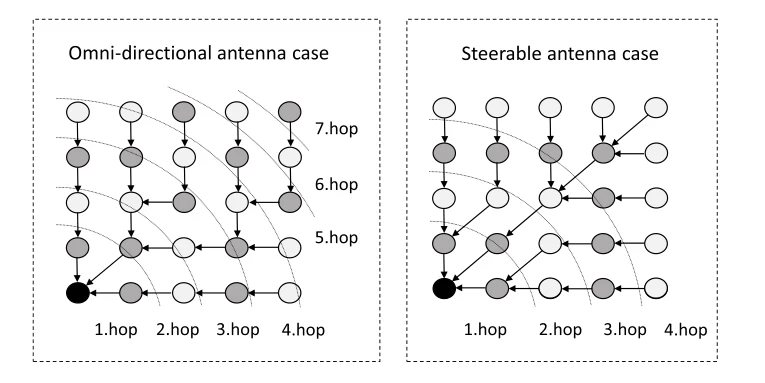
Dt = 15 ms, Ls = 51. Per unit C, Table 1 gives 296 cells (omni) vs 240 (steerable, ~25% fewer thanks to fewer hops) plus a fixed 80 autonomous cells: +8% at 1 s, −6% at 0.5 s.
5 · Performance Evaluation · Table 2
Evaluation Setup in Contiki / COOJA
COOJA was extended with steerable antennas and the deterministic path-loss model of Eq. (2). Three scenarios:
- Omni: standard 6TiSCH with omni-directional antennas.
- Steerable: steerable antennas, broadcasts in a random direction.
- SAA6: steerable antennas, broadcasts as unicast copies in autonomous cells toward the best direction.
Static nodes, 0 dBm, half-duplex; the root has three switchable 120° antennas that can emulate omni.
| Slotframe / autonomous | 51 / 397 |
| Timeslot | 15 ms |
| Shared cells omni / steerable | 3 / 1 |
| Tx range omni / interference | 50 / 100 m |
| Tx range steerable | 15–80 m |
| EB period | 16–50 s |
| DIO interval | 4.096–1048.576 s |
| Inter-node distance | 40 m |
| Area / duration | 320 × 320 m / 2 h |
5 · Performance Evaluation · Fig. 6
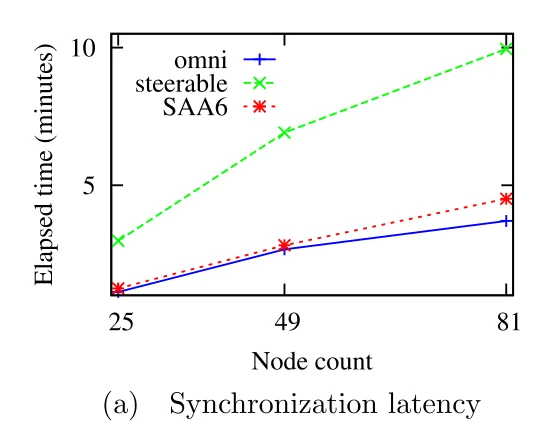
Results for the 81-Node Network
6 · Discussion
Discussion and Limitations
Direction lets more links share a time slot and channel, which shows up as higher PDR when channels are scarce.
Narrow beams slow synchronization; autonomous cells recover most of it at a fixed extra cost that pays off under heavy traffic.
Random directions give no upper bound on discovery time; faster EB/RPL frames would help but cost energy.
Results come from COOJA with a deterministic path-loss model; real hardware and fading are future work.
7 · Conclusion
Conclusion and Future Work
- 6TiSCH can support steerable smart antennas with modest MAC and scheduling extensions (SAA6).
- RSSI-based direction learning, directional shared cells and autonomous control cells make it work without probing or negotiation.
- SAA6 beats the omni-directional stack in reliability and throughput, especially in dense networks: fewer collisions, higher PDR, lower energy.
Next steps
- Validation on real hardware under real conditions
- Machine learning for choosing the best direction
- Multi-path communication with steerable antennas to cut latency
7 · Conclusion
Check Questions
- With the paper's link model, why is the steered range about 83 m at boresight but only about 13 m behind the antenna?
- How does a node learn a neighbour's direction without sending probe frames?
- Why are broadcast frames a problem for directional antennas, and how does SAA6 handle them?
- Why do both neighbours agree on the same autonomous cell without negotiating?
- Why does SAA6 need more cells at a 1 s interval but fewer at 0.5 s?
Show answers
- G = +5 dB at θ = 0 and −15 dB at 180°; with K = 2.5 the range is 10^((0 − 52 + G + 95)/25): about 83 m vs 13 m (omni: about 52 m).
- From the RSSI of frames it already receives (EB, RPL, data): it keeps the direction with the highest RSSI per neighbour.
- A narrow beam reaches only some neighbours. SAA6 copies the frame as unicast to each neighbour in cells dedicated to that pair, steered to its best direction.
- Both compute the same hash of the two node IDs: the sender's Tx cell equals the receiver's Rx cell.
- The 80 autonomous cells are fixed, while the hop savings scale with traffic (C): at 1 s, 240 + 80 > 296; at 0.5 s, 480 + 80 < 592.
References
Selected References
- X. Vilajosana et al., "IETF 6TiSCH: A tutorial," IEEE Commun. Surveys Tuts., vol. 22, no. 1, pp. 595–615, 2020.
- M. Burtowy, M. Rzymowski, L. Kulas, "Low-profile ESPAR antenna for RSS-based DoA estimation in IoT applications," IEEE Access, vol. 7, pp. 17403–17411, 2019.
- T. Voigt, L. Mottola, K. Hewage, "Understanding link dynamics in wireless sensor networks with dynamically steerable directional antennas," EWSN, 2013.
- S. Duquennoy et al., "Orchestra: Robust mesh networks through autonomously scheduled TSCH," ACM SenSys, 2015.
- S. Kim, H.-S. Kim, C. Kim, "ALICE: Autonomous link-based cell scheduling for TSCH," IPSN, 2019.
Supported by TÜBİTAK, grant 118E289. Figures are reproduced from the article (CC BY 4.0); Fig. 6 is split into panels.