Research Article · Turkish Journal of Electrical Engineering & Computer Sciences · Vol. 27, No. 6 · 2019
Enabling Space Time Division Multiple Access in IETF 6TiSCH Protocol
Summary
At a Glance
6TiSCH schedules radio resources in time and frequency. When few channels are free (Wi-Fi leaves only four 802.15.4 channels untouched), that is not enough. Switchable directional antennas add space as a third dimension.
Cooja/Contiki extended with 2 or 3 switchable directional antennas per node.
A distributed scheduling function that allocates (slot, channel, antenna) triples.
Minimal, Orchestra and SF-DA with 1, 2 and 3 antennas on 25–73 node grids.
1 · Introduction
Why Add Space to 6TiSCH?
- IoT nodes will share crowded spectrum with Wi-Fi, Bluetooth and dense 5G cells: more co- and adjacent-channel interference.
- Omni-directional antennas limit spatial reuse: per-node throughput falls as Θ(1/√(n log n)) in random networks (Gupta–Kumar).
- Directional antennas focus energy: longer range for the same power, fewer collisions, fewer retransmissions, longer lifetime.
- Only channels 15, 20, 25 and 26 avoid Wi-Fi, so 6TiSCH frequency diversity is limited in practice.
Hidden terminals, deafness and synchronization make directional MACs hard, especially on RPL trees. 6TiSCH helps: its schedule is collision-free by design, and SF-DA records each neighbour's direction.
2 · Related Work
How Much Can Directional Antennas Help?
Electronically switched antennas in WSNs (Mottola et al.) beat omni-directional nodes.
Pick the antenna with the best RSSI (Voigt et al.); reliable mainly with line of sight.
Minimal (shared cells), Orchestra (hash-based autonomous), MSF (random cells; collisions between non-neighbours).
3 · 6TiSCH · Fig. 1
6TiSCH: Schedules in Time and Frequency
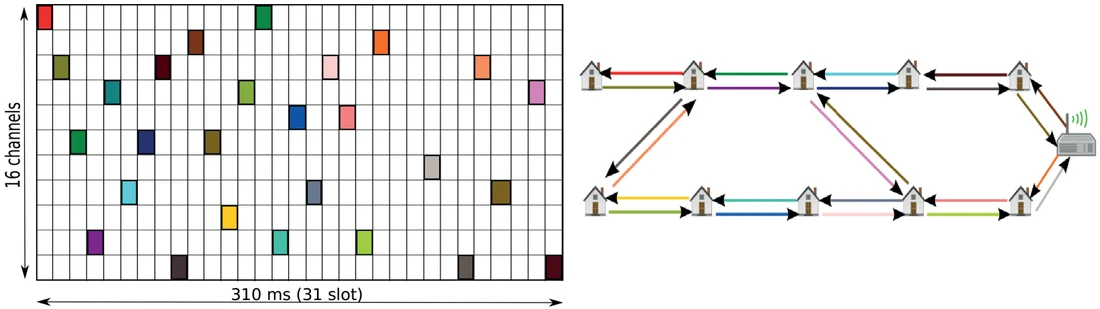
- A slotframe (here 31 cells × 10 ms = 310 ms) repeats; each cell is a (time slot, channel offset) pair. Distant pairs may reuse a cell.
- 6top, between 6LoWPAN and the TSCH MAC, adds, deletes and relocates cells between neighbours (6P); the standard leaves the scheduling policy open.
- Enhanced Beacons in hard slots carry slotframe size, slot duration, hopping pattern and the network-wide slot counter.
- Longer slotframes save energy; shorter ones cut delay.
4 · System Model · Fig. 2
A Switchable Directional Antenna Model for Cooja
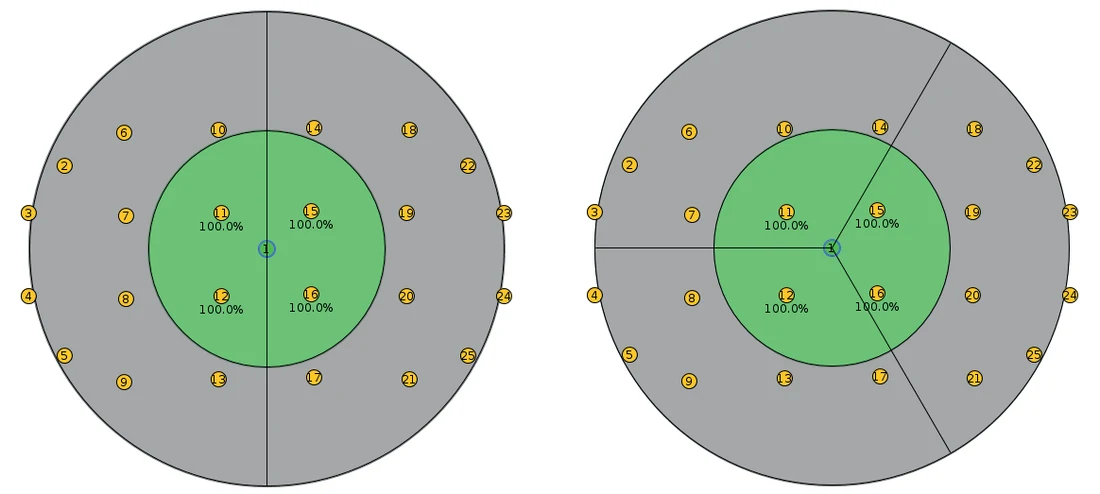
TI exp5438 (MSP430F5438 + CC2420) gets three radio interfaces on extra SPI ports; in reality one radio behind an RF switch.
Cooja's UDGM (transmit and interference ranges) now also checks the transmission direction from the node coordinates.
The arrival direction is passed up the stack and stored in the MAC neighbour table, so unicast frames leave over the antenna facing the receiver.
4 · Space Time Scheduling · Fig. 3
Omni vs Space Time Scheduling
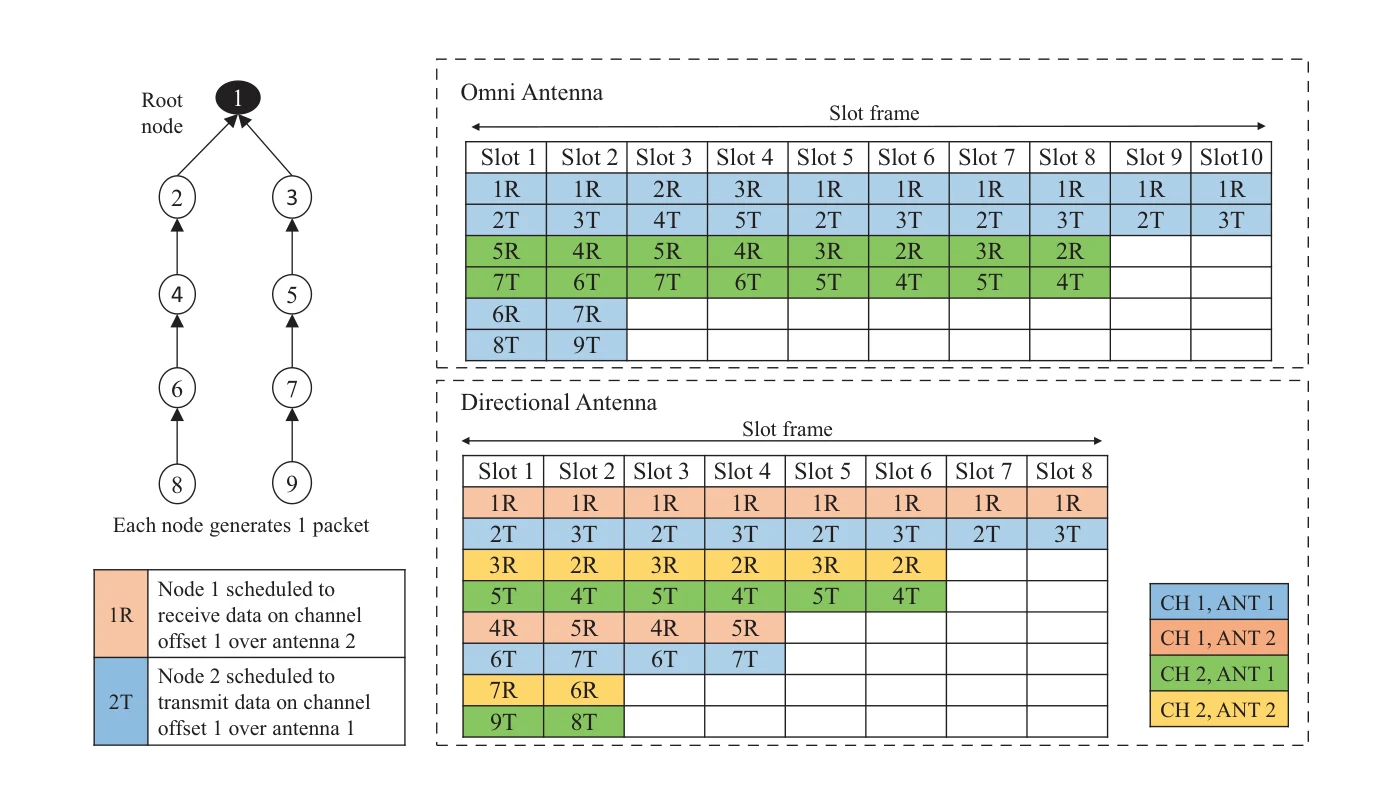
Nine nodes, root 1, two channels, each node sends one packet. Omni antennas need a 10-slot schedule; with directional antennas, pairs facing away from each other share slots and the same packets arrive in 8 slots. Cells become (slot, channel, antenna) triples.
4 · Space Time Scheduling · Interactive
Scheduler Playground: Add Antennas, Add Channels
Simplified greedy scheduler on the Fig. 3 tree, not the paper's SF-DA: 40 m spacing, 100 m interference, half-duplex nodes; a receiver is disturbed only by a same-channel transmitter whose active antenna covers it and that its own listening antenna faces.
4 · Space Time Scheduling · Algorithms 1–2
SF-DA: Directional-Antenna-Aware Scheduling
- Shared slot: listen on all antennas (learn neighbour directions) or send on all antennas.
- Transmit slot: broadcast on all antennas; unicast on the antenna facing the destination.
- Receive slot: listen only on the antenna facing the scheduled neighbour.
- Cell statistics are kept per antenna, since each direction sees different interference.
- Pick a random slot the parent does not use, then a random channel not on the failed list.
- Reject it if a 1-hop neighbour uses the same slot and channel and the antennas would face each other in opposite modes,
- or the same mode with antennas that do not match.
- Otherwise return (slot, channel, antenna).
EB frames carry the arrival angle; the paper assumes it can be estimated accurately.
5 · Results · Table 1, Figs. 4–5
Setup, and Antennas in Shared Slots
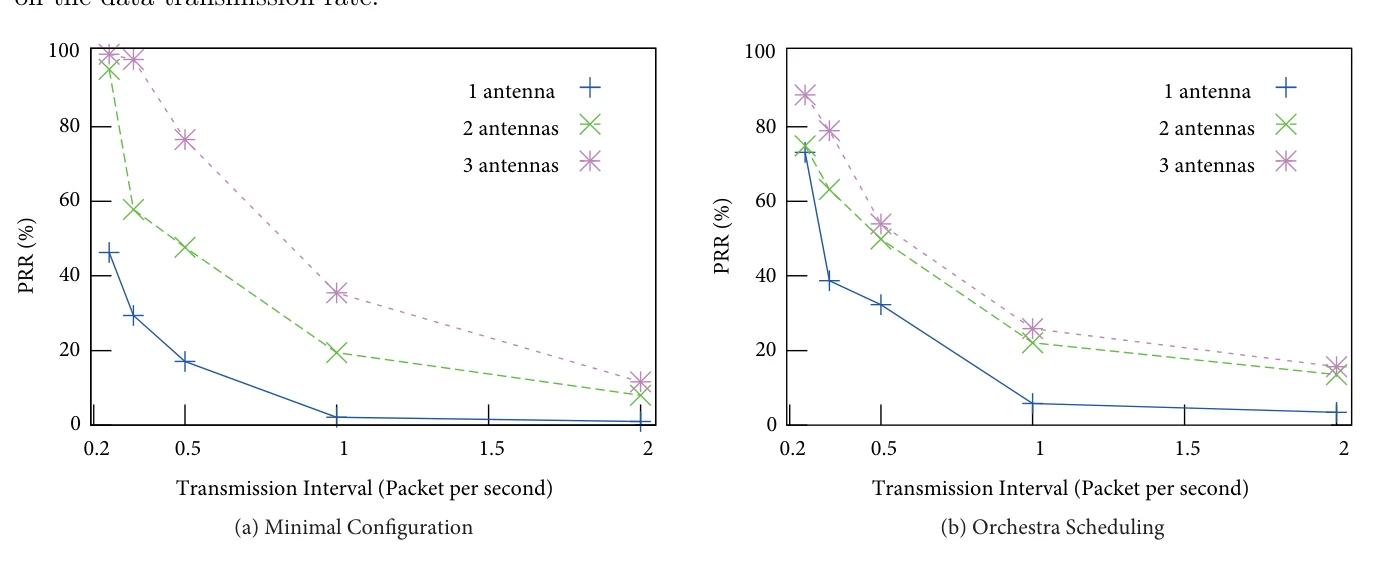
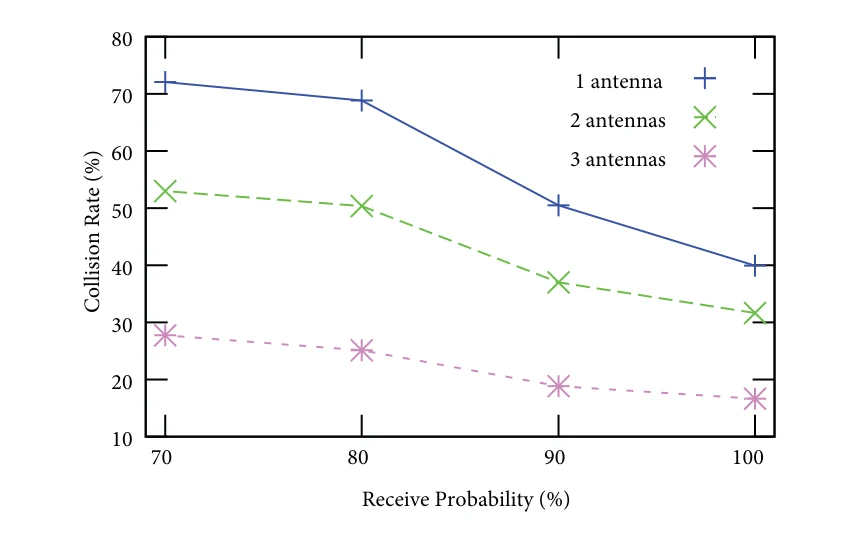
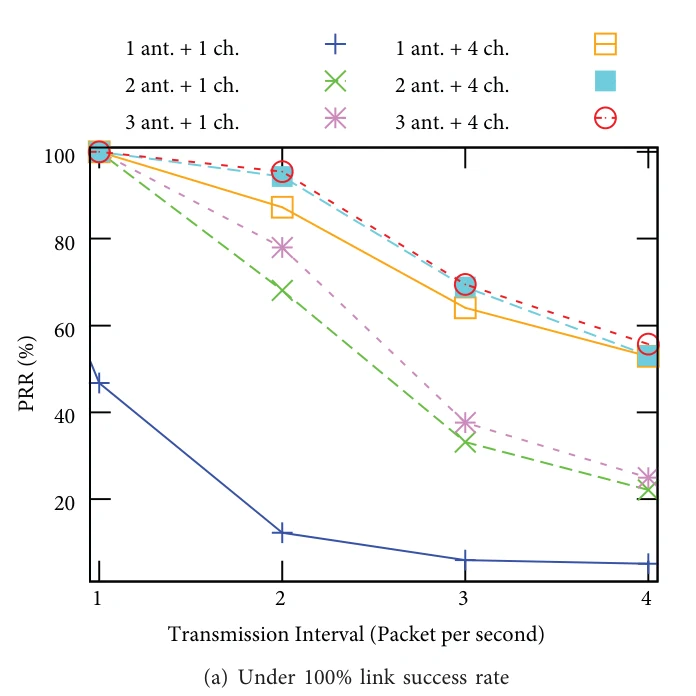
Minimal configuration and Orchestra only use shared cells. Sending on the right antenna already raises PRR 2–3× as traffic grows, although receivers still listen on all antennas.
| Grid / area | 25 nodes, 200 × 150 m |
| Antennas | 2 × 180° or 3 × 120° |
| Tx / interference range | 50 / 100 m |
| Timeslot / slotframe | 15 ms / 15 |
| Retransmissions / buffer | 5 / 5 |
| Test duration | 2 h |
5 · Results · Figs. 6–7
SF-DA: PRR, Delay and Energy
5 · Results · Table 2
Scaling with Network Size
Bigger networks mean longer paths: PRR falls, delay and energy rise. Three antennas add about 5–10 points of PRR, roughly halve the delay (1,267 → 536 ms at 25 nodes) and cut energy by about 60% (3.21 → 1.26 mWh).
6 · Conclusion
Conclusion and Future Work
- A low-complexity switchable directional antenna lets 6TiSCH schedule in time, frequency and space.
- Even schedulers unaware of antennas (minimal, Orchestra) gain from sending on the right antenna.
- SF-DA brings up to 100% higher PRR under heavy traffic with few channels, about half the delay and much lower energy.
- Gains are largest in dense, interference-limited networks; with many free channels they shrink.
Limits and next steps
- Simulation with an idealized arrival-angle estimate and UDGM propagation
- Real antenna hardware and realistic channel models
6 · Conclusion
Check Questions
- Why does limited spectrum (four Wi-Fi-free channels) make space a valuable resource for 6TiSCH?
- What is the capacity gain factor for three 120° antennas at both ends?
- Why do minimal configuration and Orchestra improve only partly with directional antennas?
- When does SF-DA reject a candidate cell?
- Why do directional antennas also save energy?
Show answers
- With few channels, distributed schedulers often pick the same channel offset; a third dimension lets those cells coexist without colliding.
- 2π / √(αβ) = 360° / 120° = 3.
- They send on the right antenna but receivers still listen on all antennas in shared cells, so interference is only partly suppressed.
- When a 1-hop neighbour uses the same slot and channel and the two antenna directions would conflict (facing each other in opposite modes, or mismatched in the same mode).
- A narrower beam needs less transmit power for the same range (180° ≈ half of omni), and fewer collisions mean fewer retransmissions.
References
Selected References
- P. Gupta, P. R. Kumar, "The capacity of wireless networks," IEEE Transactions on Information Theory, 46(2), pp. 388–404, 2000.
- S. Duquennoy et al., "Orchestra: Robust mesh networks through autonomously scheduled TSCH," ACM SenSys, 2015.
- X. Vilajosana, K. Pister, T. Watteyne, "Minimal IPv6 over the TSCH mode of IEEE 802.15.4e (6TiSCH) configuration," IETF RFC 8180, 2017.
- T. Voigt, L. Mottola, K. Hewage, "Understanding link dynamics in wireless sensor networks with dynamically steerable directional antennas," EWSN, 2013.
- P. Li, C. Zhang, Y. Fang, "The capacity of wireless ad hoc networks using directional antennas," IEEE Transactions on Mobile Computing, 10(10), pp. 1374–1387, 2011.
See the full article for the complete reference list. Figures are reproduced from the article (CC BY 4.0); some are cropped or split for interaction.