Legends: The People I Love Most in My Professional Life
Published:
The people I love most in my professional life, the ones I learned the most from. Through their code, their books, their questions and their passion, they made me love this work. Hover over or tap a face.
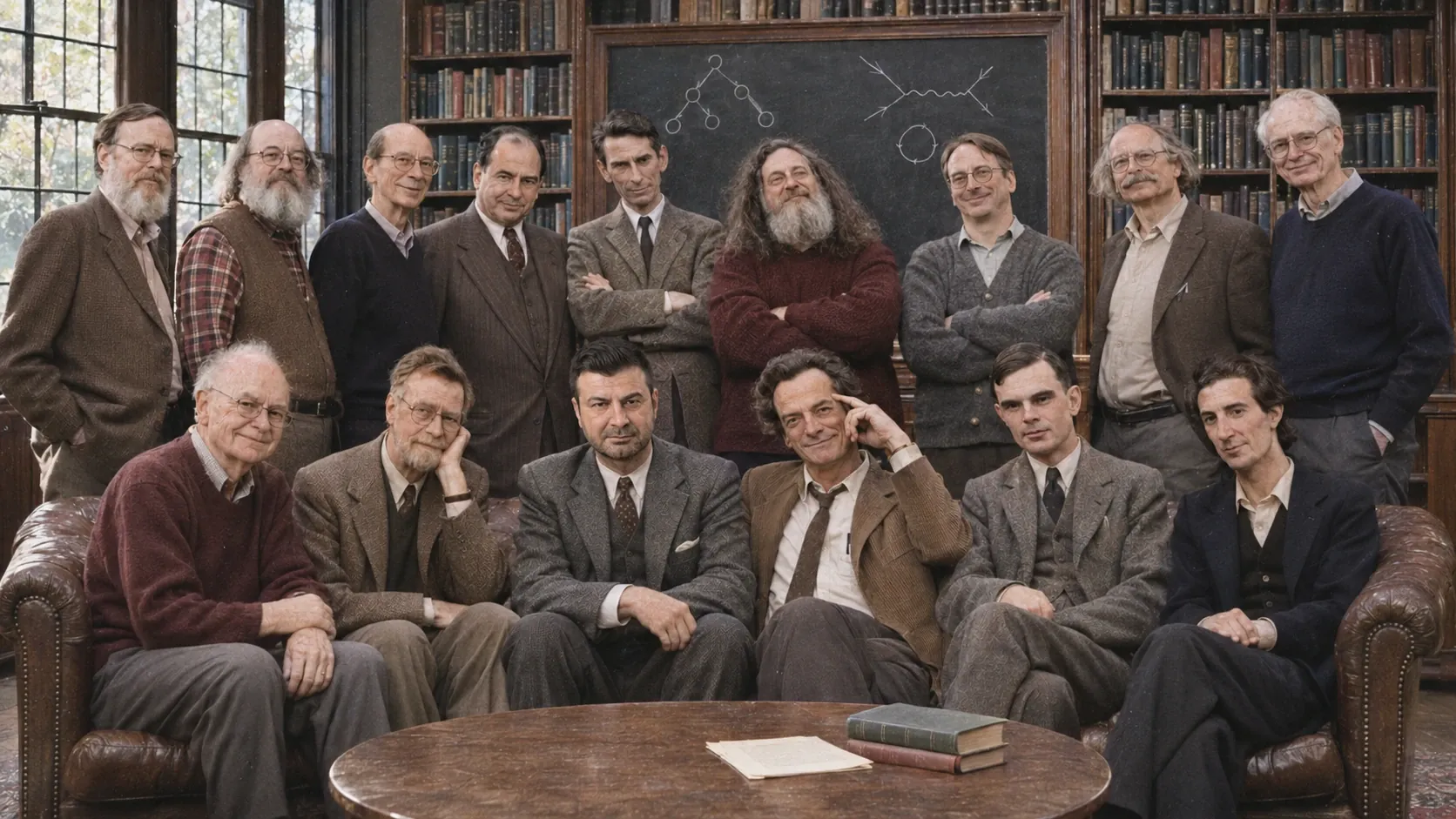
An illustration made with AI; these people never gathered like this.
- 1Dennis Ritchie 1941–2011Created C and, with Thompson, Unix.
- 2Ken Thompson 1943–Co-created Unix, B, UTF-8 and Go.
- 3Andrew S. Tanenbaum 1944–MINIX, and the operating systems and networks books generations learned from.
- 4John von Neumann 1903–1957The stored-program architecture; a founder of game theory.
- 5Claude E. Shannon 1916–2001The father of information theory; he gave us the bit.
- 6Richard Stallman 1953–The GNU project and the free software movement.
- 7Linus Torvalds 1969–The Linux kernel and Git.
- 8Bjarne Stroustrup 1950–The creator of C++.
- 9Brian Kernighan 1942–Co-author of The C Programming Language; the K in AWK.
- 10Donald E. Knuth 1938–The Art of Computer Programming, TeX and the analysis of algorithms.
- 11Edsger W. Dijkstra 1930–2002Shortest paths, semaphores and structured programming.
- 12
- 13Richard Feynman 1918–1988Quantum electrodynamics and Feynman diagrams; a master at explaining.
- 14Alan Turing 1912–1954The Turing machine, computability, Enigma, and the first question of AI.
- 15Leonardo Fibonacci ~1170 – ~1250Brought Hindu–Arabic numerals to Europe; the Fibonacci sequence.
Life stories
Dennis Ritchie 1941–2011
Dennis Ritchie was born on September 9, 1941, in Bronxville, New York. His father, Alistair E. Ritchie, was a longtime scientist at Bell Labs, and the family soon moved to Summit, New Jersey, where Dennis went to school. He studied physics and applied mathematics at Harvard, graduating in 1963. His undergraduate years, he later said, "convinced me that I was not smart enough to be a physicist," while computers were quite another matter. In 1968 he finished a doctoral thesis on the theory of computation but never formally received the degree; the thesis, long thought lost, was found after his death and published by the Computer History Museum in 2020.
He joined Bell Labs in 1967 and first worked on Multics, a joint project with MIT and General Electric. When Bell Labs pulled out in 1969, Ritchie and Ken Thompson set out to build something far smaller and simpler, and by the end of that year the first recognizable version of Unix was running. In the early 1970s Ritchie developed C, building on Thompson's B language. By 1973 the Unix kernel had been rewritten in C, making Unix one of the first operating systems written in a high-level language and easy to move to new hardware. The C Programming Language, written with Brian Kernighan in 1978 and known simply as "K&R," taught generations of programmers, and his reference manual became the basis of the ANSI C standard of 1989.
With Thompson he received the Turing Award in 1983, the 1998 National Medal of Technology, presented by President Bill Clinton in 1999, and the Japan Prize in 2011. Colleagues remember him as modest and generous; in one account of Unix history he suggested readers take "we" to mean "Thompson, with some assistance from me." He officially retired in 2007 but kept coming to Bell Labs every day. He died in October 2011, at 70, at his home in Berkeley Heights, New Jersey, where he lived alone. Much of the software we use today still rests on what he quietly built.
Ken Thompson 1943–
Ken Thompson was born on February 4, 1943, in New Orleans, Louisiana. His father's military career kept the family moving around the United States and abroad. He studied electrical engineering and computer science at the University of California, Berkeley, completed his master's degree in 1966, and joined the research staff of Bell Labs that same year.
At Bell Labs he first worked on Multics. After the company withdrew from the project in 1969, he began designing a new operating system while trying to run his game Space Travel on a little-used PDP-7. That summer his wife took their year-old son to visit his parents in California for three weeks, and in those quiet weeks Thompson wrote the core pieces of the first Unix. Grown together with Dennis Ritchie, Unix and its spare design shaped most operating systems that followed. Thompson also created B, the direct predecessor of C, and his work on regular expressions and the ed editor shaped tools programmers still use. His 1983 Turing Award lecture, shared with Ritchie, was "Reflections on Trusting Trust," showing that a backdoor hidden in a compiler cannot be found by reading source code; it remains a founding text of software security.
Belle, the chess machine he built with Joe Condon, won the 1980 World Computer Chess Championship. He later worked on Plan 9, and in 1992, with Rob Pike, he designed the UTF-8 encoding on a placemat in a New Jersey diner; today it carries most of the text on the web. He left Bell Labs at the end of 2000, joined Google in 2006, and there, with Robert Griesemer and Rob Pike, created the Go language, begun in 2007 and announced in 2009. Besides the Turing Award, he received the 1998 National Medal of Technology (presented in 1999) and the Japan Prize in 2011. One remark of his captures his taste for simplicity: "One of my most productive days was throwing away 1,000 lines of code."
Andrew S. Tanenbaum 1944–
Andrew Stuart Tanenbaum was born in New York City on March 16, 1944, and grew up in suburban White Plains, where he worked as an electrician on his high school's stage crew. His road into computing ran through physics: he earned a bachelor's degree in physics from MIT in 1965 and a Ph.D. in astrophysics from the University of California, Berkeley, in 1971. He then went to Amsterdam and never left. He became a professor of computer science at the Vrije Universiteit, married a Dutch wife, and kept his American citizenship.
His greatest gift was making operating systems something a student could actually study. In 1987 he wrote MINIX, a small UNIX-like system of about 12,000 lines for the IBM PC, to accompany his book Operating Systems: Design and Implementation. The source code came in the book's appendix and on floppy disks, and within months the Usenet group devoted to MINIX had tens of thousands of subscribers. In Helsinki, a young Linus Torvalds read the book and began writing his own kernel, Linux, while using MINIX; their Usenet debate over kernel design is still remembered. Tanenbaum also led the teams behind the Amoeba distributed operating system and the Amsterdam Compiler Kit. His textbooks, including Structured Computer Organization, Modern Operating Systems, and Computer Networks, have been translated into more than twenty languages and taught generations.
He retired in 2014 and became professor emeritus. He received the ACM Karl V. Karlstrom Outstanding Educator Award (1994) and the IEEE James H. Mulligan Jr. Education Medal (2007), and he is a Fellow of both the ACM and the IEEE. The 2023 ACM Software System Award went to MINIX, which by then was quietly running inside the management engine of Intel processors in millions of computers. Tanenbaum says he considers teaching his most important work. In his spare time he takes photographs, researches genealogy, and since 2004 has run a website that analyzes U.S. election polls.
John von Neumann 1903–1957
John von Neumann was born Neumann János on December 28, 1903, in Budapest. A year behind Eugene Wigner at school, he had published major mathematical papers before turning twenty. He studied chemical engineering at ETH Zurich while earning a mathematics doctorate in Budapest, finishing both in 1926. After working with David Hilbert in Göttingen and lecturing in Berlin and Hamburg, he moved to Princeton in the early 1930s and in 1933 became one of the first professors of the Institute for Advanced Study.
His range was astonishing. In 1928 he proved the minimax theorem for two-person zero-sum games, and Theory of Games and Economic Behavior (1944), written with Oskar Morgenstern, made game theory a core tool of economics. On the Manhattan Project he worked out the mathematics of the explosive lenses for the implosion bomb. His 1945 First Draft of a Report on the EDVAC was the first detailed written description of a computer that keeps program and data in the same memory; the design still bears his name, though the ideas grew out of joint work with Eckert and Mauchly. At Los Alamos he developed Stanislaw Ulam's Monte Carlo idea into a method that could run on ENIAC, and in Princeton he led the building of the IAS computer.
Appointed to the Atomic Energy Commission in 1955, he was diagnosed with cancer that same year. In 1956 he received the Medal of Freedom and the Enrico Fermi Award. Illness kept him from finishing his Silliman Lectures for Yale; the manuscript appeared posthumously as The Computer and the Brain (1958). He died at Walter Reed Hospital in Washington on February 8, 1957, at 53. Nearly every computer today still follows the plan his report described.
Claude E. Shannon 1916–2001
Claude Elwood Shannon was born on April 30, 1916, in Petoskey, Michigan, and grew up in nearby Gaylord. In high school he worked as a Western Union messenger, and he was a distant relative of Thomas Edison. In 1936 he earned degrees in electrical engineering and mathematics from the University of Michigan, then went to MIT, where he worked on Vannevar Bush's differential analyzer.
Its relay circuits led him to one of the most influential master's theses ever written. A Symbolic Analysis of Relay and Switching Circuits, written in 1937 and published in 1938, showed that Boolean algebra could be used to design switching circuits, laying the theoretical foundation of digital design. He earned his MIT doctorate in 1940 and joined Bell Laboratories in 1941. A Mathematical Theory of Communication, published in two parts in the Bell System Technical Journal in 1948, founded information theory: it treated information as a measurable quantity and set the limit on how much can be sent reliably over a noisy channel. It also brought the word "bit," which Shannon credited to his colleague John Tukey, into the language of science.
Shannon took play seriously. In 1950 he built Theseus, a relay-controlled mechanical mouse that learned its way through a maze, and wrote a paper on programming a computer to play chess. He juggled and rode a unicycle through the halls of Bell Labs. In 1949 he married Betty (Mary Elizabeth Moore), a numerical analyst there. From 1958 to 1978 he was Donner Professor of Science at MIT.
He received the National Medal of Science in 1966 and the Kyoto Prize in 1985. After years with Alzheimer's disease, he died in Medford, Massachusetts, on February 24, 2001. Every compressed file, mobile connection and error-correcting code rests on the foundations he laid.
Richard Stallman 1953–
Richard Matthew Stallman was born in New York City on March 16, 1953. He entered Harvard in the fall of 1970 and graduated magna cum laude with a bachelor's degree in physics in 1974. Already in 1971, during his first year at Harvard, he had started working as a programmer at the MIT Artificial Intelligence Laboratory. He began graduate study in physics at MIT but left after a year to devote himself to programming. At the lab, in 1976, he developed the Emacs text editor.
In 1980 the lab received a new Xerox laser printer, and the company refused to provide its source code. Unable to add the features he had built for the old one, Stallman became convinced that users must be free to modify their software. In September 1983 he announced the GNU project, an operating system made entirely of free software. He began work on January 5, 1984, and left his job at MIT to devote himself to it. He published the GNU Manifesto in 1985 and founded the Free Software Foundation in October of that year. He wrote GNU Emacs, the GCC compiler, and the GDB debugger himself. He invented the idea of copyleft and, working with lawyers, wrote the GNU General Public License; its first program-independent version appeared in 1989. When GNU tools were joined with the Linux kernel in the early 1990s, the result was a complete free operating system, which is why Stallman asks that the system be called GNU/Linux.
In 1990 he received both a MacArthur Fellowship and the ACM Grace Murray Hopper Award for his pioneering work on Emacs. He won the EFF Pioneer Award in 1998, was elected to the U.S. National Academy of Engineering in 2002, and has received many honorary doctorates. In 2019 he resigned from his position at MIT and as president of the FSF, and in 2021 he returned to the FSF board of directors. He continues to lead the GNU Project.
Linus Torvalds 1969–
Linus Benedict Torvalds was born in Helsinki on December 28, 1969, the son of journalists Nils and Anna Torvalds. At eleven he began programming on a Commodore VIC-20, and later took apart and modified a Sinclair QL. In 1988 he started studying computer science at the University of Helsinki, interrupting his studies for military service in 1989. Andrew Tanenbaum's book about MINIX sparked his fascination with operating systems.
On January 5, 1991, he bought an Intel 80386 PC and, frustrated with the limits of MINIX, set out to write his own kernel. On August 25, 1991, he told the MINIX newsgroup that it was "just a hobby" and would not be big and professional like GNU. He had wanted to call the project "Freax," but Ari Lemmke, who ran the FTP server where it was first hosted, named the directory "linux," and the name stuck. Torvalds soon moved the kernel to the GNU GPL, which let volunteers from around the world contribute to the code. Linux 1.0 was released on March 14, 1994. His master's thesis was titled Linux: A Portable Operating System. In 2005, when the free license for BitKeeper, the tool the kernel developers used, was withdrawn, he wrote Git, which has since become the shared tool of the software world.
In 1997 he joined Transmeta in California, working there until 2003, then moved to the Open Source Development Labs, the forerunner of today's Linux Foundation, and settled with his family in Oregon. He became a U.S. citizen in 2010. He was named a Computer History Museum Fellow in 2008, shared the 2012 Millennium Technology Prize with stem cell researcher Shinya Yamanaka, and received the IEEE Computer Pioneer Award in 2014. He has guided the kernel's development for more than three decades, and in 2001 he told the story in the book Just for Fun.
Bjarne Stroustrup 1950–
Bjarne Stroustrup was born on December 30, 1950, in Aarhus, Denmark, into a working-class family, and went to local schools. He entered Aarhus University in 1969 and earned a cand.scient. degree in mathematics and computer science in 1975. In 1979 he completed a PhD on distributed computing at the University of Cambridge under David Wheeler.
That same year he moved to New Jersey to join the Computer Science Research Center at Bell Labs in Murray Hill. While working on distributing operating system services across a network, he wanted a tool that combined the clean program organization encouraged by Simula 67 with the speed and efficiency of C. In 1979 he began work on a language he called "C with Classes," and wrote both its first implementation and, later, Cfront, the compiler for C++, himself. The name C++ came from his colleague Rick Mascitti in the summer of 1983. The first commercial release appeared in October 1985, the same year his book The C++ Programming Language was published. Standardized in 1998, C++ became a core language wherever performance matters, from operating systems and games to browsers and finance. He headed the Large-scale Programming Research department, from its creation at AT&T Bell Labs until late 2002.
He taught at Texas A&M University from 2002 to 2014, worked at Morgan Stanley from 2014 to 2022, and became a professor at Columbia University in 2022. His honors include election to the National Academy of Engineering (2004), the IET Faraday Medal (2017), and the 2018 Charles Stark Draper Prize for conceptualizing and developing C++. He lives in New York with his wife, Marian; their daughter is a physician and their son a research professor in systems biology. He enjoys history, photography, hiking, and running. Asked how to say his surname, he likes to point out that its first "u" really should have been a "v."
Brian Kernighan 1942–
Brian Wilson Kernighan was born on January 30, 1942, in Toronto, Canada. While studying engineering physics at the University of Toronto, he saw his first computer, an IBM 650, in his second year, and began programming in his third, learning Fortran. After graduating in 1964 he went to Princeton, which did not yet have a computer science department. He wrote his thesis on graph partitioning using some 6,000 punched cards and earned his PhD in electrical engineering in 1969. He then joined Bell Labs, where he had interned, and stayed about thirty years.
At Bell Labs it was Kernighan who suggested the name "Unix" for the new operating system built by Ken Thompson and Dennis Ritchie. The Elements of Programming Style, written with P. J. Plauger in 1974, taught clear code as a craft. The C Programming Language, written with Ritchie in 1978, was the first book on C, under 300 pages long, and it made the "hello, world" exercise famous around the world. Kernighan has always stressed that the design of C was entirely Ritchie's work. The "K" in AWK, the language he created in 1977 with Alfred Aho and Peter Weinberger, stands for Kernighan. From 1981 to 2000 he headed the Computing Structures Research department at Bell Labs.
After Bell Labs he returned to Princeton as a professor, where he holds the William O. Baker '39 Professorship in Computer Science. He was elected to the National Academy of Engineering in 2002. He wrote The Practice of Programming with Rob Pike and The Go Programming Language (2015) with Alan Donovan, and in 2019 published his firsthand account, UNIX: A History and a Memoir. Teaching Harvard's CS50 to more than 400 students in the fall of 1996, he asked the class to give him exact instructions for trimming his beard, to show how precise instructions must be; the experiment ended with him cutting it with hedge clippers in front of the room.
Donald E. Knuth 1938–
Donald Ervin Knuth was born in Milwaukee, Wisconsin, on January 10, 1938. His father taught at a Lutheran school and played the church organ, the source of Knuth's lifelong love of the instrument. In eighth grade he entered a candy company's contest to form as many words as possible from the letters of "Ziegler's Giant Bar"; armed with an unabridged dictionary, he found more than 4,500, while the judges' own list had about 2,500. The prize was a television set for his school and enough candy bars for every student. In 1956 he entered the Case Institute of Technology to study physics, switched to mathematics, and in 1960 received his bachelor's and master's degrees at the same time. He earned his Ph.D. in mathematics at Caltech in 1963 and joined its faculty.
In 1962 Addison-Wesley asked him to write a book on compilers. Knuth decided that he first had to lay the foundations of programming itself, and the single planned book grew into the multivolume The Art of Computer Programming, whose first volume appeared in 1968. With it he turned the analysis of algorithms into a rigorous discipline and popularized asymptotic notation. In the late 1960s he moved to Stanford University. In the 1970s, unhappy with the declining typesetting quality of his books, he devoted a decade to the problem and created the TeX typesetting system, METAFONT, and the Computer Modern typefaces. He also introduced literate programming, which treats programs as documents written for human readers.
He received the ACM Grace Murray Hopper Award in 1971, the Turing Award in 1974, the U.S. National Medal of Science in 1979, and the Kyoto Prize in 1996. He has been professor emeritus at Stanford since 1993 and spends his time on new volumes of The Art of Computer Programming. For many years he mailed small reward checks to readers who found errors in his books. He keeps a pipe organ in his home.
Edsger W. Dijkstra 1930–2002
Edsger Wybe Dijkstra was born in Rotterdam on May 11, 1930. His father taught chemistry; his mother was a mathematician. While studying theoretical physics at Leiden University, he began working in the spring of 1952 for Adriaan van Wijngaarden at the Mathematical Centre (Mathematisch Centrum) in Amsterdam, becoming the first programmer in the Netherlands. Van Wijngaarden later persuaded him that programming could become a respectable discipline, and he chose it over physics. When he married Ria Debets in 1957, officials would not accept "programmer" as a profession, so the register calls him a theoretical physicist.
In 1956, on a café terrace in Amsterdam with his fiancée after shopping, he worked out his shortest path algorithm without pencil or paper, a "twenty-minute invention," as he later called it. He used it that year to demonstrate the ARMAC computer and published it in 1959. In 1960 he and Jaap Zonneveld wrote the first ALGOL 60 compiler. In 1962 he became a professor at the Eindhoven University of Technology, where he built the THE multiprogramming system and introduced semaphores for coordinating processes.
His 1968 letter in Communications of the ACM argued against the goto statement. He had titled it "A case against the goto statement"; the famous title Go To Statement Considered Harmful came from the editor, Niklaus Wirth. He received the Turing Award in 1972. He wrote his ideas in numbered notes, mostly by hand with a fountain pen, known as EWDs; more than a thousand survive in a University of Texas archive.
From 1973 he was a research fellow of the Burroughs Corporation, working from his home in Nuenen. In 1984 he moved to the University of Texas at Austin and retired in 1999. He died of cancer at his home in Nuenen on August 6, 2002. The next year a leading prize in distributed computing was renamed the Dijkstra Prize.
Richard Feynman 1918–1988
Richard Phillips Feynman was born on May 11, 1918, in Queens, New York, and grew up in Far Rockaway. He earned his bachelor's degree at MIT in 1939 and completed his doctorate under John Wheeler at Princeton in 1942. That same year he married his sweetheart Arline Greenbaum, who was ill with tuberculosis. From 1943 to 1945 he worked on the Manhattan Project at Los Alamos, where in his spare time he amazed colleagues by opening their combination locks. Arline died in June 1945, shortly before the first bomb test.
After the war he went to Cornell and then to Caltech, where he spent the rest of his career. He rebuilt quantum electrodynamics (QED), the theory of how light and matter interact, and his diagrams, which turn particle interactions into simple drawings, became the everyday language of physics. For this work he shared the 1965 Nobel Prize in Physics with Julian Schwinger and Shin'ichirō Tomonaga. His 1959 talk at the American Physical Society meeting at Caltech, There's Plenty of Room at the Bottom, imagined engineering at the scale of atoms and inspired nanotechnology. His 1961–1963 undergraduate lectures became The Feynman Lectures on Physics. In a 1981 keynote at an MIT conference, published in 1982 as Simulating Physics with Computers, he argued that faithfully simulating nature would require computers built on quantum mechanics, one of the starting points of quantum computing.
In 1986 he served on the Rogers Commission investigating the Challenger disaster; at a televised hearing he dipped O-ring material into ice water to show that it lost its resilience in the cold. A bongo player who reached a wide audience with books such as Surely You're Joking, Mr. Feynman!, he fought cancer for years and died in Los Angeles on February 15, 1988.
Alan Turing 1912–1954
Alan Mathison Turing was born in London on June 23, 1912. At Sherborne School the death of his close friend Christopher Morcom in February 1930 shook him deeply. He entered King's College, Cambridge, in 1931 and was elected a fellow of the college in 1935. His 1936 paper On Computable Numbers described the abstract device now called the Turing machine, founding computability theory. He then completed a PhD at Princeton under Alonzo Church.
In 1939 he joined the codebreakers at Bletchley Park. He led Hut 8, which attacked German naval Enigma, and designed the bombe, an electromechanical machine for finding Enigma keys; the war work earned him an OBE. At the National Physical Laboratory he then designed the ACE, a stored-program computer. In 1948 he moved to the University of Manchester, working on software for its early computers. His 1950 paper Computing Machinery and Intelligence, published in Mind, proposed what is now called the Turing test and opened the debate on artificial intelligence. He was elected a Fellow of the Royal Society in 1951, and in 1952 he published his paper on morphogenesis on how chemical reaction and diffusion could create biological patterns. A keen long-distance runner, he ran marathons after the war.
In 1952 he was convicted of "gross indecency," then a crime in Britain, over a relationship with a man. To avoid prison he accepted a year of hormone treatment and lost his security clearance. He died at his home in Wilmslow on June 7, 1954. The inquest ruled his death a suicide by cyanide poisoning, though some have questioned that verdict. Prime Minister Gordon Brown apologized for the government in 2009; Queen Elizabeth II pardoned him on December 24, 2013. The Bank of England's £50 note bearing his portrait entered circulation on June 23, 2021, his birthday.
Leonardo Fibonacci ~1170 – ~1250
Leonardo of Pisa was probably born in Pisa around 1170. His father, Guglielmo, belonged to the Bonacci family and worked as an official representing Pisan merchants in Bugia (today Béjaïa, in Algeria) in North Africa. Leonardo joined him as a boy, was educated there, and first encountered the Hindu–Arabic numerals and the methods of calculating with them. He then traveled to Mediterranean trading centers such as Egypt, Syria, Greece, Sicily, and Provence, studying merchants' arithmetic, and returned to Pisa around 1200.
His Liber Abaci (Book of Calculation) of 1202 introduced Europe to the decimal place-value system and the Hindu–Arabic numerals; a revised second edition followed in 1228. Among its many practical examples was a problem asking how many pairs of rabbits there would be if every pair produced a new pair each month from its second month on; the answer gives the sequence 1, 1, 2, 3, 5, 8, 13, and so on—now named after him. In 1220 he wrote Practica Geometriae, a book on geometry.
His work reached scholars at the court of Emperor Frederick II, who received him in Pisa around 1225. Leonardo solved difficult problems posed by Johannes of Palermo, a member of the court, and gathered his solutions in Flos. That same year he dedicated Liber Quadratorum (The Book of Squares), a work on square numbers, to the emperor. In 1240 the Republic of Pisa granted him a salary for advising the city on accounting and for teaching its citizens.
He probably died around 1250, most likely in Pisa. He never called himself "Fibonacci"; the name, meaning "son of Bonacci," was given to him by later writers. No authentic portrait of him is known, but a nineteenth-century statue of him stands today in the Camposanto in Pisa.